


It's not "an AI chat". It's a catalog of services.
Each service is enabled by contract, per client instance, and can use a different cloud provider — the client activates what makes sense for the operation and pays for consumption directly to its cloud provider.
The 10 services in the catalog
-
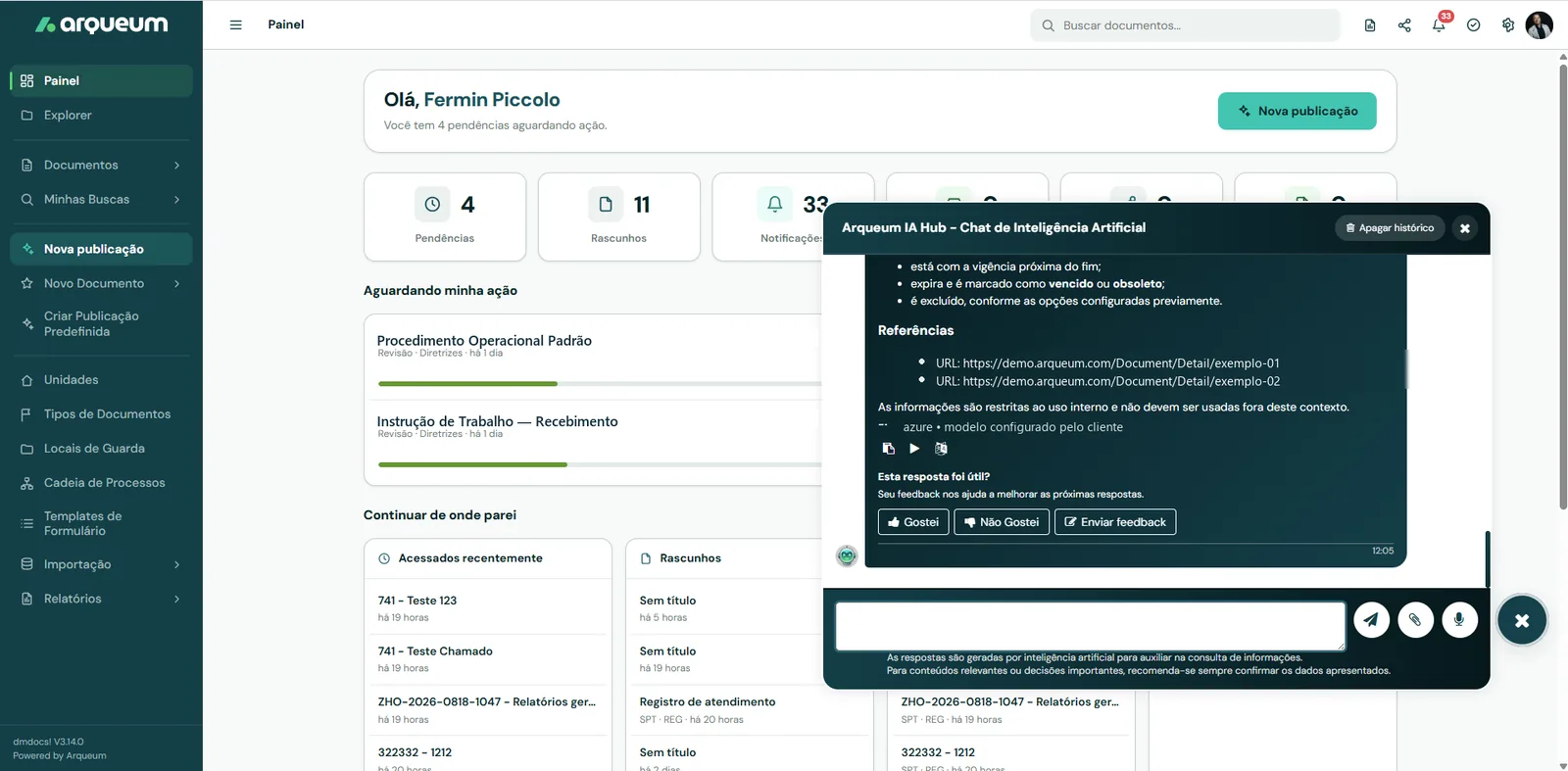
Chat with documents
Natural-language questions about the repository, with citation of the source document.
-
Semantic search
Retrieval by meaning, not just by exact keyword, with the user's permission applied.
-
Secure indexing
Prepares the repository for querying while keeping the link to the document and its permissions.
-
Document classification
Suggests filing location, document type and attributes from the content.
-
Document translation
Returns the translated file (DOCX, XLSX, PPTX, PDF) with the layout preserved.
-
Content translation
Translation of excerpts, fields and answers within the authorized environment.
-
Summarization
Summaries of a document or of a set of documents.
-
OCR and computer vision
Extracts text from scanned documents for indexing and search.
-
Read aloud
Converts the document text into audio (speech synthesis).
-
Audio transcription
Turns recordings into searchable text.
Each service is enabled per instance, with its own credential and usage log — and stays in your environment.
The AI respects the permissions defined on the documents.
A user's question does not open the entire repository. The AI considers only what they could already open, and every answer cites its source.
- 1 Identity
- 2 Permissions
- 3 Authorized documents
- 4 Semantic search
- 5 Model
- 6 Answer with sources
-
Per-client isolation
every query is scoped by the client identifier. Configuration and content do not cross that boundary.
-
One key per service
the chat key has no indexing permission, and the indexing key has no chat access.
-
Encrypted credentials
endpoints and keys are encrypted at rest and never displayed in readable form in the admin area.
-
Mandatory citation
a source the user cannot open does not enter the context.
Security and privacy, by design.
-
No public model training
content is used to answer the question, not to train a third-party model.
-
No parallel database
the index is hosted in the client's cloud and keeps the link to the document and its permissions.
-
Data residency
where documents are processed is defined in the configuration, which gives the legal team a clear answer.
-
AI notice on every surface
all AI-generated content displays a notice to verify important data.
If the user cannot open the document, the AI cannot use it to answer.
See the architecture and the service matrixFrequently asked questions
- Does Arqueum's AI use my documents to train models?
- No. Content is used to answer the question, not to train third-party models — and Arqueum does not keep the content: every step runs in the customer's own cloud subscription.
- Can the AI answer using documents the user cannot open?
- No. If the user cannot open the document, the AI cannot use it to answer: retrieval applies the user's permissions and every answer cites its source.
- Am I required to use the AI?
- No. Each AI service is enabled by contract, service by service, and the intelligence layer can be enabled or turned off without affecting the document operation — with AI off, the flow remains manual and in the same order.
- Can I use different cloud providers per AI service?
- Yes. The provider is a customer configuration, resolved at runtime — chat on one cloud and translation on another is a valid combination, and switching providers is reconfiguration, not migration.
- What does the AI service catalog include?
- Chat with documents citing the source, semantic search, automatic classification, translation of content and of documents with the layout preserved, summaries, read-aloud, audio transcription, OCR and meetings with AI — transcript, minutes, translation and dubbed video.
- Does the AI publish or decide anything on its own?
- No. The AI classifies and suggests, with a confidence level per field; nothing is published automatically — every suggestion requires validation by a user.
- How is AI service consumption billed?
- Cloud consumption is billed directly by the chosen provider, on the customer's own subscription — you enable what makes sense for the operation and pay only for that, directly to your provider.
Activate only what your operation needs.
Service by service, by contract, in your cloud.