


Fermin Piccolo
Co-founder, Arqueum
Published on · 9 min read

The race to adopt artificial intelligence at scale is in full swing: 78% of companies in 2024 report using AI in at least one business function (Stanford AI Index 2025), representing significant growth from around 50% in 2020 (McKinsey and Stanford data). This 28-percentage-point jump in 4 years reflects an unprecedented acceleration in enterprise AI adoption.
Yet behind this technological enthusiasm hides an invisible risk — the lack of data lineage.
What is Data Lineage?
In technical terms, data lineage is the ability to trace, end to end, the path a piece of data travels within the organization, including:
- Its origin (source, entry system, training dataset);
- All the transformations it undergoes (cleaning, aggregation, enrichment, anonymization, etc.);
- The intermediate systems it passes through (pipelines, data lakes, models, reports);
- Its final uses (automated decisions, management reports, AI model outputs).
Data lineage works as the “DNA of information” in the company — a structured record of the complete history of every relevant piece of data.
Why does Data Lineage matter now (or why should it always have mattered)?
Without this transparency, executives can be blindsided by problems they cannot immediately see: regulatory non-compliance, hidden biases, misuse of data and loss of operational efficiency.
For leaders, it is critical to translate these technical concepts into practical business impacts. A clear example: high-risk AI systems (those affecting sensitive areas such as healthcare, transportation, finance, hiring, etc.) will be subject to strict documentation and monitoring obligations under the EU AI Act.
The European AI law requires, for example, detailed activity logs to ensure traceability and complete technical documentation for up to 10 years (under Article 18 of the EU AI Act). Why does this matter? Because if your company cannot prove where the data feeding its AI models comes from and how it is processed, you may be unable to meet these requirements — and not even know it until it is too late.
According to an MIT study, the lack of transparency about data lineage in AI models can leave companies out of compliance with new regulations such as the EU AI Act. In other words, without data visibility, regulatory risk becomes an invisible time bomb.
Tangible and Intangible Costs
Beyond the legal aspect, there are tangible and intangible costs associated with the lack of data lineage:
-
Regulatory Fines: For non-compliance with the AI Act, companies can face fines of up to €35 million or 7% of global annual revenue — whichever is higher. This even exceeds GDPR sanctions (€20 million or 4%) and signals the weight authorities will give to responsible AI.
-
Risk of Biases and Errors: Data without clear lineage can contain errors or biases that go unnoticed, leading to misguided or unfair business decisions. Imagine a recruiting algorithm trained on incorrect or biased data — without tracing the origin of that data, the company exposes itself to reputational and legal risk over possible discrimination.
-
Operational Inefficiency: The lack of data lineage also erodes efficiency. IT and compliance teams waste time hunting for information scattered across disconnected systems, making audits and rapid incident responses harder. Studies show that data lineage is the foundation of trust and accountability in corporate data management.
-
Prolonged Exposure: Without it, errors remain hidden for longer, increasing the risk of non-compliance penalties and undermining informed decision-making.
The Urgency of Compliance: EU AI Act Timeline
The regulatory clock does not stop. The EU AI Act, the world’s first comprehensive legal framework for AI, is coming into force in a phased, progressive manner:
Implementation Timeline
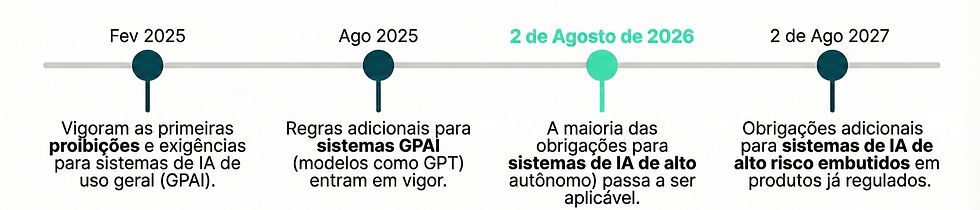
In short: 2026 is the critical milestone for “pure software” high-risk systems, while 2027 closes the regulatory net for many embedded systems. Compliance planning needs to account for this progression, not just a single date.
Authorities will make it clear: AI without Governance will not be tolerated
The EU AI Act’s rules take a risk-based approach:
- High-risk AI systems will need to meet strict transparency requirements (such as dataset documentation and explainability of results),
- General-purpose AI (GPAI) models — such as large language models like GPT — now carry transparency obligations, albeit lighter ones.
In other words, it does not matter whether your company develops complex AI solutions or merely integrates APIs of off-the-shelf models: if there is an impact on the European market, compliance demands will come knocking at your door.
The scope is extraterritorial — even companies outside the EU are subject to it if their systems process data or deliver outputs that affect people in Europe. And, in any case, the same concepts, risks and treatments apply in every region of the world. Sooner or later, every country or economic bloc will have legislation like the European Union’s – more or less strict, but they will!
Data Lineage as a Strategic Solution
Given this scenario, what is the practical next step? The immediate, strategic answer is to invest in Data Lineage and AI governance. This is not a bureaucratic requirement, but the foundation for compliance and trust in artificial intelligence systems.
The Backing of Leading Research Institutions
Major technology players and institutes have been emphasizing this point:
- Microsoft highlights that the AI Act will demand retention of technical documentation for a decade, something impossible to manage without a strong data management framework.
- MIT’s Data Provenance initiative (linked to institutions such as MIT and the academic community) shows that without traceability of training datasets, corporations are exposed to legal violations, leakage of sensitive information and unintentional algorithmic bias.
It is clear that data lineage is not a “nice-to-have” — it is a prerequisite for responsible, auditable AI.
Practical Implementation: Concrete Tools and Solutions
In practice, implementing data lineage means equipping your organization with tools and processes to map the path of data from the source all the way to the automated decision. This involves:
- Cataloging training and production data,
- Documenting transformations (ETLs, cleaning, aggregations),
- Recording which models or reports consume each piece of data,
- Monitoring access and changes in real time.
Sounds complex? Yes, and that is precisely why many companies have postponed this work. However, new market solutions make this journey easier.
Examples of available solutions:
- Automated Data Lineage Platforms (such as Collibra, BigID and similar tools) can automate much of the tracking, with capabilities for automatic data discovery, flow mapping and lineage visualization (upstream/downstream).
- Data Catalog and Governance Tools integrate data cataloging, audit trails, model management and documentation in one place.
- Data Provenance Initiatives (such as MIT’s Data Provenance Initiative) work specifically to bring transparency to the datasets used in training AI models.
These solutions allow every AI decision to be explained and justified in moments. For example, with a good lineage system, if an auditor asks “where did the data that fed this credit algorithm come from?”, your team can answer quickly with concrete evidence, instead of panicking and digging through scattered spreadsheets.
Practical Examples: Why Data Lineage Prevents Non-Compliance
-
Credit Granting Model without Traceability of Training Data
- Problem: It is impossible to demonstrate whether biased data (for example, discriminatory histories) was used.
- Risk: Non-compliance with the AI Act’s requirements of non-discrimination, transparency and explainability for high-risk systems.
- Solution: Data lineage makes it possible to trace all datasets, detect biases and document data-handling decisions.
-
Resume Screening System without a Record of Transformations
- Problem: The company cannot demonstrate how candidate data was normalized, pseudonymized or filtered.
- Risk: Vulnerability to accusations of algorithmic discrimination and breach of transparency and technical documentation obligations.
- Solution: Every transformation is recorded, enabling audits and proof of compliance.
-
Fraud Detection Tool Trained on Multiple Databases without Documentation of Origin
- Problem: Lack of clarity about which sources were used, whether there was consent, whether usage restrictions exist.
- Risk: Conflicts with the AI Act and with the GDPR, especially regarding the legal basis for processing and the purpose.
- Solution: Data lineage documents origin, consents and uses, facilitating compliance with GDPR + AI Act.
-
Customer Service Chatbot Using Historical Personal Data without a Consent Trail
- Problem: There is no clear traceability of which data entered the model, when and under which legal basis.
- Risk: Extreme difficulty in handling access/deletion requests (data subject requests) and in proving compliance during an audit.
- Solution: Lineage makes it possible to respond quickly to personal data requests and demonstrate compliance.
Without data lineage, the company cannot “tell the story” of its data — not to itself, and not to regulators.
Impact by Sector: Where the Pressure Is Greatest
The urgency is not uniform. Specific sectors face even greater regulatory pressure:
Healthcare
- Applications: AI in diagnosis, exam prioritization, treatment recommendations.
- Risk: Input data errors or untraceable biases can affect fundamental rights (life, integrity, non-discrimination).
- AI Act: Many of these cases qualify as high risk, requiring robust documentation, event logging and explainability — all dependent on good data lineage.
Finance
- Applications: Credit granting, risk scoring, fraud monitoring, dynamic pricing.
- Risk: Algorithmic decisions directly affect access to essential services.
- AI Act: Without data lineage, it is nearly impossible to explain why a given customer was rejected or received a certain rate, which is critical for explainability, non-discrimination and accountability requirements.
Human Resources (HR)
- Applications: AI used in resume screening, candidate ranking, performance evaluations.
- Risk: Regulators and courts have already shown high sensitivity to biases in recruitment systems.
- AI Act: The absence of lineage opens gaps for non-compliance with equal opportunity principles and with AI Act requirements for systems affecting access to employment.
In sectors such as healthcare, finance and HR, where AI-influenced algorithmic decisions can directly affect fundamental rights, the lack of data lineage is not just a technical risk — it is an immediate regulatory and reputational risk. In these contexts, data lineage ceases to be a “good practice” and becomes a minimum requirement for operating AI at scale.
Beyond Compliance: Data Lineage as a Strategic Differentiator
The benefits go far beyond “avoiding fines”.
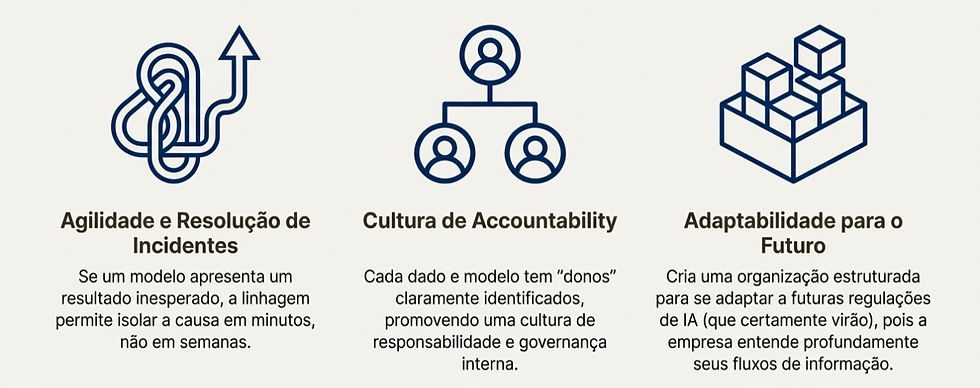
And perhaps most importantly: with data lineage, the company develops an adaptive capability — as new regulatory requirements emerge (and they will, globally), your organization will be structured to adjust policies and processes quickly, because it already understands its information flows in depth.
In short, data lineage is a long-term solution that turns compliance from a burden into a strategic differentiator.
Preparing the Next Step
The message for executives could not be clearer: ignoring the invisible risk is not an option.
Compliance with the EU AI Act in 2026-2027 will require immediate action to build solid foundations of AI governance — and data lineage is the first pillar to be raised.
Companies that act now to map and control their data and models will not only be avoiding sanctions, but also reaping rewards in efficiency and market trust.
After all, in a world increasingly governed by AI, transparency and accountability will be as important as the technology itself.
Do not leave your organization exposed. Schedule a strategy session or request a demonstration with specialists in data lineage and AI governance, and find out how to take the next steps toward responsible AI that is compliant and truly aligned with business goals.
This is the moment to turn hidden risk into an opportunity for leadership — before 2026 arrives and decides, on its own, who the winners and losers of the artificial intelligence era will be.