


Fermin Piccolo
Co-founder, Arqueum
Published on · 9 min read

Estimates in the corporate governance field indicate that about 90% of today’s digital data was generated in the two most recent years alone. As organizations seek to turn this ocean of information into actionable knowledge, Artificial Intelligence (AI) – and especially generative AI (GenAI) – emerges as an indispensable ally.
The pace of adoption is impressive. The Artificial Intelligence Index Report 2025 highlights that 78% of companies were already using AI in 2024, up from 55% in 2023. Market research shows that more than 90% of organizations say they use or are exploring AI – corresponding to more than 300 million companies globally – and 92% plan to increase AI investments over the next three years. In addition, about 50% of professionals who use AI receive little or no formal training.
Meanwhile, only 15.9% of Brazilian companies have a formal GenAI strategy, according to the Mapa GenAI no Brasil survey (MIT Technology Review Brasil).
This article draws a parallel between the Brazilian and global landscapes, discusses barriers and opportunities, and shows how strategy, governance and technology can transform companies and society.
The landscape
Weak governance and information overload
-
A sea of data. The Big Data phenomenon has made information overload a concrete challenge. The estimate that 90% of digital data was created in the last two years reinforces the need for knowledge management methods. Conceptual research shows that knowledge is an intangible asset and a source of competitive advantage.
-
Accelerated adoption with little structure. Globally, 78% of companies use some form of AI and 71% already use GenAI in at least one business function. However, more than 90% are still experimenting or in the early stages, and roughly half of professionals lack formal training. This mismatch fuels Shadow AI – when employees use AI tools without leadership’s knowledge.
-
Strategy and leadership in Brazil. The Mapa GenAI no Brasil survey heard from 350 organizations and revealed that 73% are already discussing GenAI, but only 15.9% say they have a formal strategy; 52.6% are drafting a strategy and 31.4% have not yet started that process. In 47.3% of companies, responsibility for GenAI is shared internally; 27.5% have no designated owner and 75% do not have a professional dedicated exclusively to the topic – highlighting leadership gaps.
-
Governance, ethics and risks. The same study shows that 56.6% of companies consider the Brazilian General Data Protection Law (LGPD) very or partially influential in AI adoption, but 46.1% have no ethical guidelines whatsoever for the use of AI. The main barriers cited for GenAI adoption are internal conflicts (20.8%), reputational risks (19.9%) and uncertainty about ROI (14.8%).
-
Skills and technical culture. Only 17.7% of Brazilian companies assess that their teams have a high level of GenAI knowledge; 39.4% consider their skills average; 35.4% low; and 7.5% say they have no GenAI skills at all. As for implementation, 36.7% are running pilot projects, 25.7% have partial integration, 7.9% have already fully integrated GenAI and 29.7% have not started any initiatives in this area. In short, there is a significant skills and structure gap for AI in Brazilian organizations.
The global picture versus Brazil
The table below summarizes indicators on AI and GenAI adoption worldwide versus in Brazil:
| Indicator | World | Brazil | Notes |
|---|---|---|---|
| AI use | 78% of organizations use AI and more than 90% explore or use AI; 92% plan to increase AI investments. | 73% of companies discuss GenAI, but only 15.9% have a defined formal strategy. | Global maturity is more advanced; in Brazil there is interest, but little formalization. |
| GenAI use | 71% of companies use GenAI in at least one business function. | 36.7% in pilot projects, 25.7% with partial integration, 7.9% with full integration; 29.7% with no GenAI initiatives. | Brazil is still taking its first steps toward integration. |
| Skills | About 50% of professionals who use AI have little or no formal training. | 17.7% consider their teams highly skilled; 39.4% moderately; 35.4% with low skills; 7.5% with none. | Lack of training is an evident barrier. |
| Governance and ethics | A McKinsey study points out that talent gaps and regulatory uncertainty are frequent obstacles to AI adoption. | 47.3% share GenAI leadership; 27.5% have no designated owner; 75% have no dedicated professional; 46.1% have no ethical guidelines for AI. | Fragile governance and the lack of ethical guidelines are clear obstacles in Brazil. |
The data shows that, although there is strong interest, organizational maturity for GenAI in Brazil is still low. Barriers include the lack of strategy, skills gaps and the absence of governance and ethical guidelines.
Inefficiencies and wasted time
The current landscape is not limited to adoption metrics: it shows up in teams’ daily routines. An analysis by the McKinsey Global Institute indicates that interaction workers (highly skilled professionals such as managers and analysts) spend 28% of their week managing e-mail and nearly 20% searching for internal information. This wasted time undermines productivity and innovation. Without adequate platforms, data overload turns into cognitive overload: decisions are made based on incomplete information and tasks are duplicated unnecessarily.
Combined with the lack of a GenAI strategy and governance, these factors reveal operational inefficiencies, compliance risks and loss of competitiveness. Changing this picture requires rethinking processes, technology and culture.
The answer: saving time and generating value with GenAI
Greater efficiency and productivity
-
Automation and ROI. An economic impact study conducted by Forrester Consulting concluded that process automation delivered an ROI of 248% over three years, with a net present value of US$ 39.85 million for the composite organization analyzed. By eliminating repetitive tasks and speeding up workflows, employees recover hundreds of hours that can be invested in strategic initiatives. Integrating GenAI amplifies this gain by taking over research and information-synthesis tasks.
-
Agility and centralized access to information. Modern document management platforms centralize versions and records, allowing teams to find what they need in seconds. Intelligent search with natural language processing retrieves the right information at the right time and logs changes to ensure transparency, reducing cognitive overload and improving decision-making.
-
Compliance and traceability. Robust systems ensure that policies and retention periods are met automatically, minimizing the risk of fines and sanctions. The Ponemon Institute report The True Cost of Compliance with Data Protection Regulations shows that the costs of non-compliance are 2.71 times higher than the costs of compliance. In absolute terms, the average annual cost of compliance is US$ 5.47 million, versus an average loss of US$ 14.82 million for non-compliant organizations. Investing in automation and AI therefore reduces the financial and reputational risks associated with non-compliance.
-
Better decision-making. With the “house in order”, scattered data turns into unified information and knowledge. Semantic search and versioning ensure that reports are complete and up to date, strengthening corporate governance. By reducing the time spent looking for data and speeding up analysis, leadership can focus on strategic decisions based on reliable information.
Breaking through barriers toward sustainable adoption
-
Establish a solid GenAI strategy. Define clear objectives (such as increasing productivity, driving innovation or reducing costs) and ROI metrics for AI initiatives. In Brazil, only 15.9% of companies have a formal GenAI strategy – building a roadmap is the first step to move beyond pilots and advance in maturity.
-
Create governance and ethics structures. Appoint owners for GenAI, bring IT, legal and compliance teams together, and adopt codes of ethics for AI use. The Brazilian report shows that 46.1% of organizations have no ethical guidelines for AI; clear policies are urgent. The LGPD and the Brazilian AI Plan can serve as an initial basis for regulatory and ethical guidance.
-
Invest in training and culture. Lack of training is a recurring issue: globally, about 50% of professionals who use AI received little or no formal training, and only 17.7% of Brazilian companies consider their teams highly skilled in GenAI. Ongoing training programs, hackathons and communities of practice reduce Shadow AI and increase the team’s technical competence.
-
Ensure secure, scalable infrastructure. Choose solutions that allow integration with your preferred cloud providers and keep data under the organization’s control, ensuring privacy and compliance. Hybrid or private cloud architectures can offer flexibility without compromising security.
Arqueum + Arqueum AI Hub: managing processes and documents
Arqueum exemplifies how AI can transform knowledge management. Replacing legacy systems, the solution goes beyond simple archiving:
-
Semantic search and language understanding. Enables searches by content and context. For example, a manager can search for “personnel movement rules” and the system returns the right documents even if they use different terms, thanks to semantic indexing and natural language processing.
-
Information analysis. Turns raw data into actionable insights with interactive dashboards and custom reports. It identifies trends and patterns and supports evidence-based strategic decision-making.
-
Summaries and insights. Concise summaries of long, complex documents, highlighting the most relevant points. It saves time and lets you focus on the information that is critical to your business.
-
Automatic version control. The system notifies you when a document needs updating, routes it for review and archives previous versions, reducing compliance risks and ensuring everyone accesses the latest version.
-
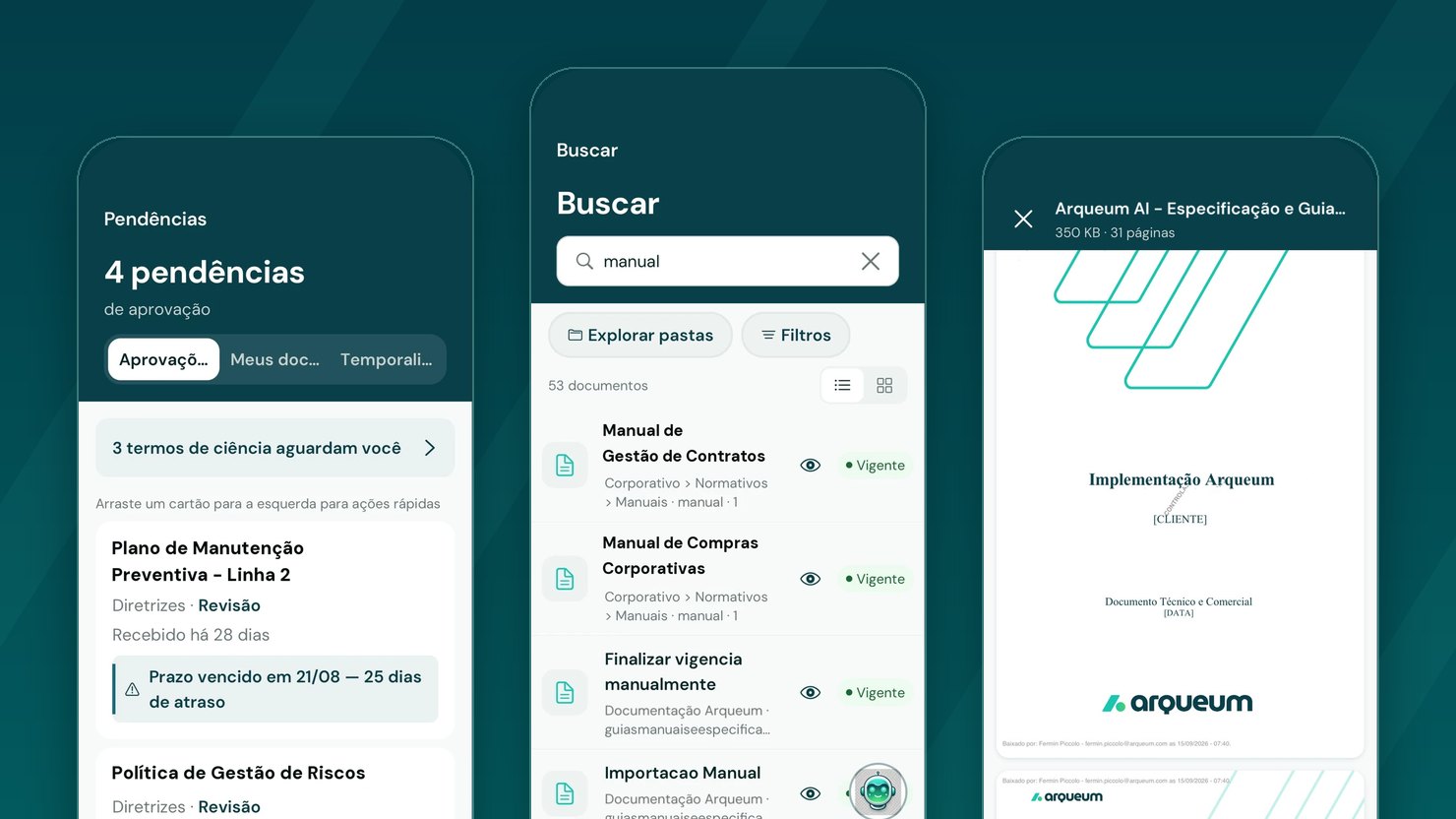
Mobile access and usability. With an intuitive interface and mobile compatibility, information is accessible “at the right time, in the right place”. For example, field supervisors can check procedures on their smartphones before performing hazardous tasks, increasing safety and operational efficiency.
-
Stronger governance. The platform reinforces document and process governance, ensuring compliance and providing indicator reports (such as the average time to find information). This makes it possible to identify bottlenecks and opportunities for continuous improvement.
To expand this value even further, Arqueum has placed AI at the center of product innovation. The Arqueum AI Hub allows customers to connect AI services (GenAI, translation, speech synthesis, document recognition, etc.) to the cloud provider of their choice (Azure, AWS or GCP). Data remains stored in the company’s infrastructure, ensuring confidentiality and privacy, while AI features can be enabled or disabled as needed. This model promotes safe and responsible AI, optimizes costs and gives organizations autonomy.
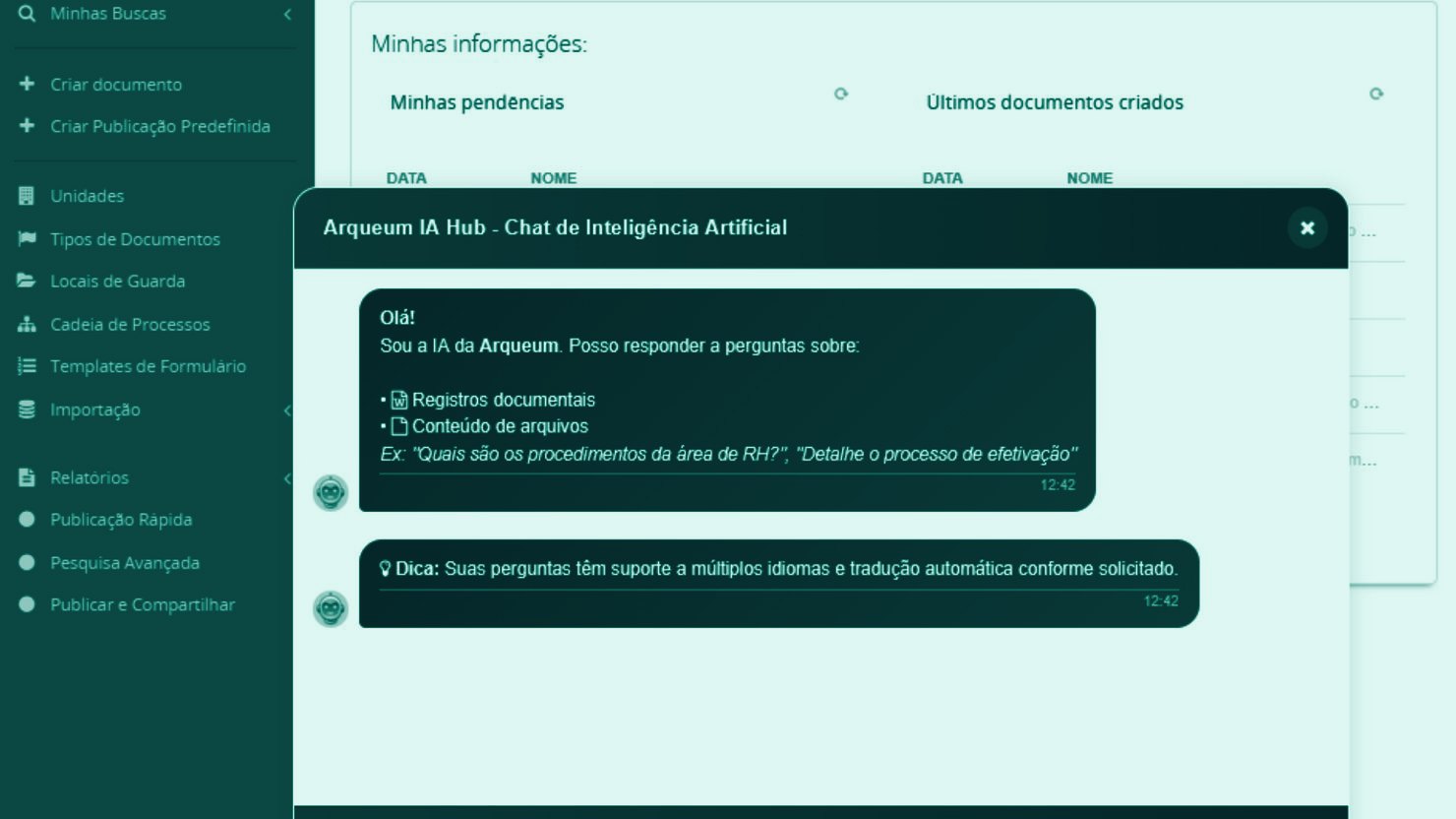
With the AI Hub, processes and documents can be queried in natural language: an employee asks “what are the steps to approve a supplier?” and the system answers based on the available processes, forms and documents – always respecting the user’s access context. The AI will not use content the employee does not have access to in order to provide the answer.
By freeing up time and making knowledge easier to access, technology allows analysts and managers to focus on strategies that generate value for the organization and for society.
Final thoughts
The comparative overview shows that GenAI is already a concrete reality, but its full adoption requires overcoming structural barriers. Although 78% of companies worldwide use AI, few have integrated it with robust governance and ethics. In Brazil, the debate is advancing, but formal strategies are still rare and skills and budget gaps persist.
For tools such as GenAI and other AI solutions to deliver sustainable results, leaders need to rethink processes, invest in training and establish governance and ethics structures. Integrating AI into knowledge management – as demonstrated by Arqueum – eliminates wasted time, improves compliance and enhances decision-making. The Arqueum AI Hub proves that it is possible to innovate without giving up security: data remains under the customer’s control, while GenAI services are enabled as needed.
This is the time to turn enthusiasm into strategic action: establish a vision for the future, train teams and adopt platforms that combine automation and AI with governance, security and ethics. That way, organizations will be prepared to thrive in the AI-driven knowledge economy, converting the flood of data into competitive advantage and value for society.